

R.E.M.O.T.E. Leadership: A Curious Framework for Leading Remote and Hybrid Teams
As remote and hybrid work becomes the norm, leaders everywhere are asking the same question:
How do you lead effectively when your team isn’t in the same room?
The truth is, remote leadership doesn’t need to be harder, it’s simply different.
It requires new habits, new rhythms, and a willingness to rethink old assumptions.
This is where the R.E.M.O.T.E. Leadership Coaching Framework comes in.
It’s a simple, reflective model designed to help leaders navigate the unique challenges of remote team management with clarity and curiosity.
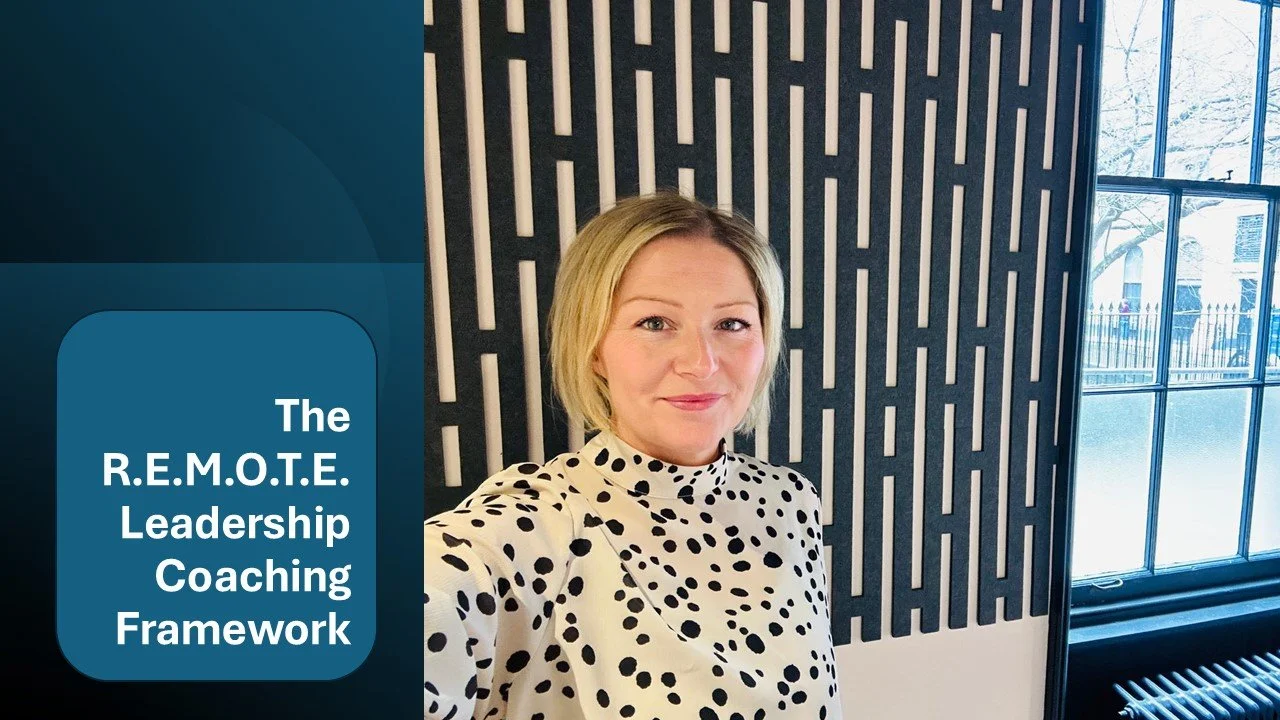
R.E.M.O.T.E. Leadership Coaching Framework
Whether you’re coaching leaders, developing your own leadership style, or supporting a distributed team, this framework offers a practical way to strengthen connection, culture, and performance.
What Is the R.E.M.O.T.E. Leadership Framework?
R.E.M.O.T.E. stands for:
R — Relationships & Trust
E — Expectations & Clarity
M — Mindset Shift (Outcomes > Activity)
O — Operational Rhythm
T — Team Well‑Being & Sustainability
E — Engagement & Culture
Each element addresses a core challenge of leading remote teams from communication gaps to burnout to maintaining culture across distance.
Let’s explore each one.
R — Relationships & Trust in Remote Teams
One of the biggest challenges in remote leadership is building trust without physical proximity.
In a hybrid or distributed environment, trust isn’t built through hallway chats, it’s built through intentional connection.
Key questions for leaders
How do you help your team feel seen and valued?
Who might be drifting to the edges of the team?
What rituals create genuine connection?
Strong relationships are the foundation of high‑performing remote teams.
E — Expectations & Clarity
Ambiguity is amplified when people work remotely.
Without clear expectations, remote teams waste time, duplicate effort, and lose momentum.
Ask yourself
Would everyone on your team name the same top priorities?
Where might people be guessing instead of knowing?
Are roles, responsibilities, and decision‑rights explicit?
Clarity is one of the most powerful productivity tools in remote leadership.
M — Mindset Shift: From Activity to Outcomes
Traditional leadership often relies on “seeing the work.”
Remote leadership requires a shift toward outcome‑based management.
Reflect on
Are you measuring effort or results?
Where might you be unintentionally micromanaging?
What would trusting your team more look like?
Outcome‑focused leadership empowers autonomy and boosts performance.
O — Operational Rhythm
Remote teams thrive on rhythm, not randomness.
A clear operational cadence reduces noise, prevents misalignment, and supports async communication.
Consider
What rhythms keep your team aligned?
Which meetings could become async updates?
How predictable is your communication flow?
A strong rhythm creates stability in distributed teams.
T — Team Well‑Being & Sustainability
Burnout is harder to spot in remote work — and easier to hide.
Leaders need new ways to check in with curiosity, not surveillance.
Ask
How do you know when someone is struggling?
What signals might you be missing?
Are workloads visible and manageable?
Sustainable performance requires psychological safety and healthy boundaries.
E — Engagement & Culture in Remote Work
Culture doesn’t disappear in remote teams, it becomes invisible unless you intentionally bring it into view.
Explore
What does culture look like when “here” is everywhere?
How do you create moments of connection and belonging?
What rituals reinforce your values?
Engagement is built through shared meaning, not shared space.
Why the R.E.M.O.T.E. Framework Works
This framework helps leaders:
Improve communication across remote and hybrid teams
Strengthen trust and psychological safety
Reduce meeting overload through async communication
Build a healthy, sustainable team culture
Increase clarity, alignment, and accountability
Support employee engagement from anywhere
It’s not a checklist, it’s a way to explore what your team truly needs in a distributed world.
Final Thought
Remote leadership isn’t about mastering tools or running perfect meetings.
It’s about curiosity, clarity, and connection.
When leaders approach remote work with intention, they don’t just adapt, they evolve.
Contact me for a chat.