

Why your greatest strength might be holding you back
Both in your career and your personal life, your strengths are your brand. They’ve propelled your career, built your reputation, shaped your leadership style.
But what if those same strengths, when overused, are your biggest blind spot? And why, when you see someone doing the absolute opposite, does it trigger you more deeply than it should?
This is the paradox at the heart of the Core Quadrant Model, a deceptively simple but profound framework developed by Daniel Offman. It’s a tool I often use in leadership coaching to help clients uncover the hidden dynamics behind their behaviours, triggers and potential for growth.
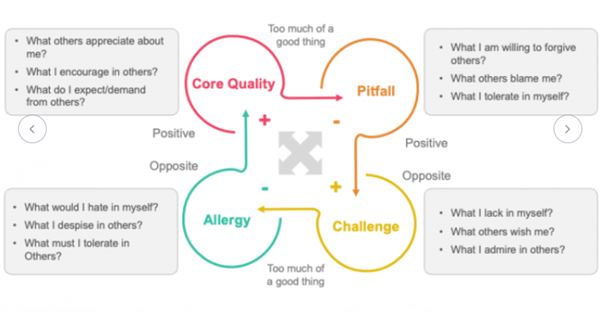
Adapted from Daniel Ofman’s Core Quadrant Model.
This model helps us move from reactivity to reflection, and ultimately toward integration - the ability to lead without being led by your inner triggers and emotions.
A real-world leadership example:
Let’s say your core quality is drive. You’re action-oriented, results-focussed, and relentless in pursuit of goals.
But under pressure:
• Your pitfall might be impatience or micromanagement.
• Your challenge is to develop patience and strategic delegation.
• Your allergy? You may feel triggered by team members who seem slow, hesitant, or overly cautious.
Here’s the insight: that “annoying” behaviour in others may reflect a trait you’ve underdeveloped - and need to integrate to grow as a leader.
Your experience of the world, family influences, cultural expectations, and early career lessons, has shaped both your core qualities and the allergies that trigger you. In Transactional Analysis (TA), we talk about drivers (the unconscious “pushes” that shape your strengths, like Be Perfect, Please Others, Try Hard, Be Strong, Hurry Up) and interjects (the internalized messages you absorbed, such as Don’t be selfish or Don’t show weakness).
Take the example of drive as a core quality. Perhaps you grew up with a strong ‘Hurry Up’ or ‘Be Strong’ message that rewarded action, speed, and resilience. That message helped you develop drive as a strength, but it can also lead to the pitfall of impatience or micromanagement. At the same time, you may have absorbed messages like ‘Don’t be lazy’ or ‘Don’t waste time’. These messages can make you allergic to hesitation or caution in others, even though patience and reflection are exactly the challenge you need to balance your drive.
As a coach, I use the Core Quadrant Model alongside TA to help you uncover these deeper layers. Together, we explore not just what your quadrant looks like, but why it formed the way it did. This discovery matters because when you understand the “why,” you gain freedom to choose new responses instead of repeating old patterns. It’s the difference between being driven by unconscious messages and leading from conscious choice - a shift that unlocks resilience, empathy, and authentic presence.
Why this matters in leadership roles?
Leadership isn’t just about making decisions - it’s about navigating complexity, inspiring trust, and adapting with emotional intelligence.
The Core Quadrant Model helps you:
• Decode your behavioural patterns and blind spots
• Understand interpersonal friction through a non-judgmental lens
• Build empathy for diverse leadership styles
• Develop the agility to flex between strengths and challenges
It’s not about fixing flaws - it’s about expanding your range
Want to Explore Your Core Quadrant?
If you’re curious about what your own quadrant might reveal, or how this model could elevate your leadership, I’d love to explore it with you.
Contact me to start the conversation.
Because the best leaders aren’t just strong, they’re self-aware, balanced, and always evolving.
References:
Ofman, D. (1990). Core Qualities: A Gateway to Human Resources. Utrecht: Servire
Mindset Explained. (2024). Drivers in Transactional Analysis: 5 Key Drivers Explained. Retrieved from https://mindsetexplained.com/drivers-in-transactional-analysis-5-key-drivers-explained/.
About the Author: Debbie Marshall is an Executive Leadership Coach, supporting leaders through transformative, psychologically informed coaching that fosters clarity, resilience, and authentic leadership. For more information go to her website